

Born to Diet: Diet Soda and the Making of a Fashion Ideal
As fashion enthusiasts, we’re all familiar with accessories in the traditional sense: rings, bracelets, hats, belts. But what about the accessories we don’t consider at first—the consumption choices signalling who we are that go beyond anything we can find on Vogue Runway?
For centuries, there’s been one universal symbol that has prevailed in the context of identity, status, wealth, and prestige: food. From the trade of exotic spices in the 15th century to the transformation of the lobster to culinary luxury, food has always been closely tied with money, and thus, with societal ideals of beauty, health, and wellness. In today’s culture, our snacks and drinks might even say more about us than our wardrobes do; think about the connotations behind the “hot cheeto girl” from 2023 or the luxury of purchasing a $21 Erewhon smoothie.
In the past several years, we’ve seen a fascinating influx in specific styles and aesthetics centered around food. In the 2020s, styles like “Tomato Girl”, "Sardine Girl Summer”, and most recently, the performative “Matcha Man” have all been evidence of food’s transcendence from a quiet status symbol to an explicit fashion accessory. But among the plethora of food trends, one item shines: the sleek, silver cans of diet soda.
For more than three decades, diet soda has been inextricably linked to the fashion industry. At the peak of the heroin-chic style in the ‘90s, supermodels cited a diet of cigarettes and Diet Coke as the key to staying slim. Today, diet soda is experiencing a new wave amongst it-girls as the ideal accessory, evidenced by recent themes in pop music as well as fashion industry icons taking on executive roles with Diet Coke. Diet soda isn’t just a trendy food—it’s a representation of a facet of our culture, a symbol that may point to something larger about how we express ourselves through image and brand.
What makes diet soda so fashionable?
The answer lies in branding. After switching its target audience to women in the ‘90s, Diet Coke completely infiltrated the fashion world. Sociologist and former model Ashley Mears stated, “...getting products into models’ hands was thought to be a great source of low-cost advertising.” The drink was seen everywhere in fashion, from press photos to backstage at runway shows. But it wasn’t just the models; it was designers, too.
In 2012, Diet Coke named Jean Paul Gaultier their new creative director. Before him, it was Karl Lagerfeld, a Diet Coke fanatic known to drink 10 cans a day. And most recently, in 2022, supermodel and heroin-chic icon Kate Moss was named creative director, spearheading the “Love What You Love” campaign in 2024. The appointment of these fashion figures is not only a reflection of their creative prowess, but also a deliberate statement that cements the association of the beverage with fashion. In this way, diet soda is implied to be not just a drink, but a lifestyle.
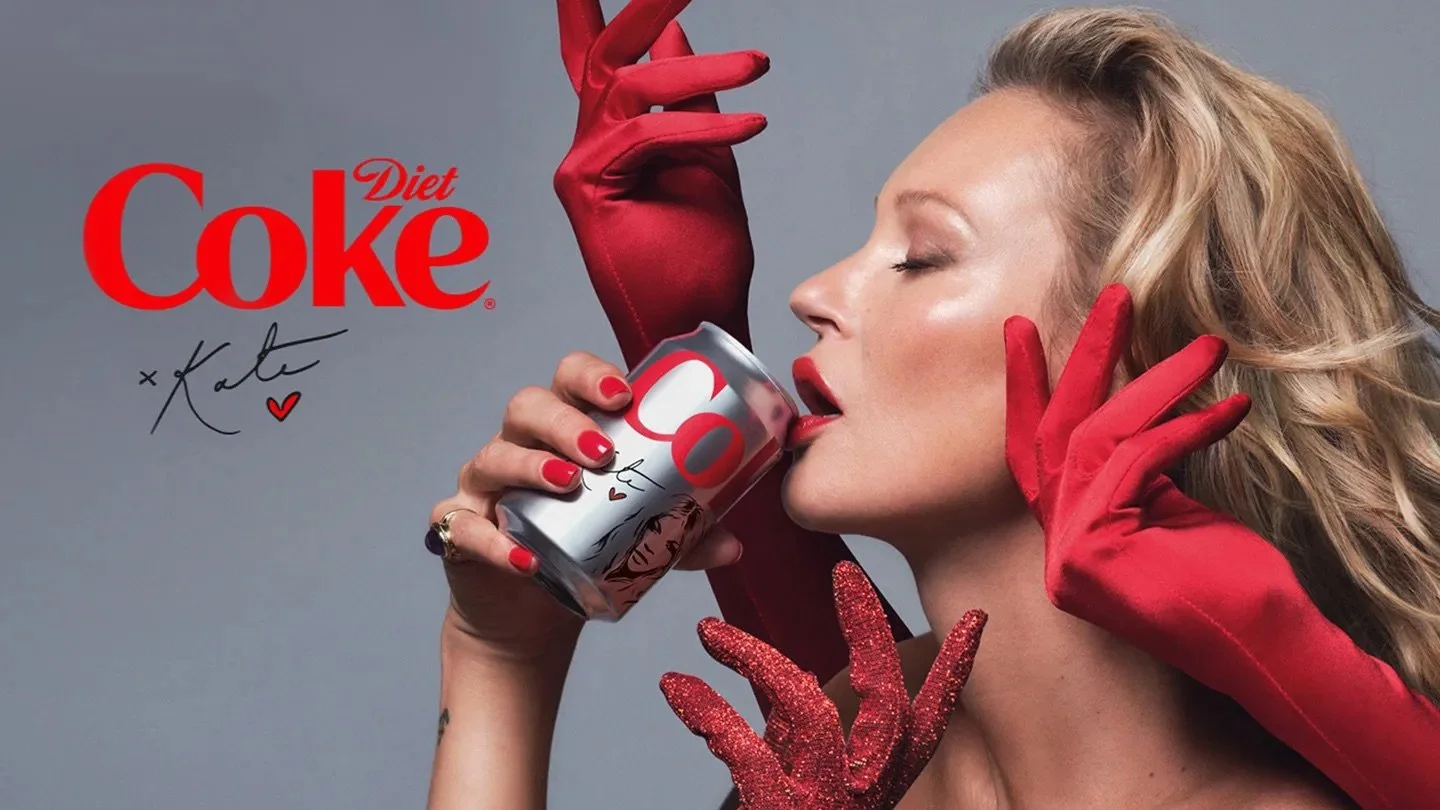
Photo courtesy of Coca-Cola Great Britain
Beyond the world of fashion, pop music has made diet soda its unofficial mascot. It’s been especially prevalent with Lana Del Rey and her associated “coquette” aesthetic—a style characterized by dainty, hyperfeminine elements like bows, lace, the color pink, and yes, metallic cans of Diet Coke. This momentum has been carried on by fresh pop icons like Addison Rae, who released her lead single “Diet Pepsi” last year to widespread critical acclaim. The track’s music video, which shows Rae dancing frivolously in leopard-print stilettos and a sequined lingerie set, has generated over 38 million views. Thanks to its endorsement from our favorite it-girls in music, diet soda has seen a complete revival of its glory from the ‘90s, becoming a symbol of both femininity, beauty, and cultural capital.

Photo courtesy of Vogue
Diet soda’s moral problem
In 2025, we’ve breathed new life into diet soda’s cultural identity, especially on the runway. While mainstream culture preached fitness and eating “clean” and embraced curvier body types in the mid-to-late 2010s, we’ve come back around (as we always do) to mark thinness as the epitome of beauty, a standard to be achieved at any cost, no matter how harmful. Diet soda, which has been marketed as low-calorie and sugar-free, has become the go-to for it-girls everywhere.
The fashion industry has also long been a key actor in maintaining and creating unrealistic standards of beauty. Models are often pressured to maintain a certain size, facing degradation over their bodies and even developing eating disorders. Although diet soda has become iconic in its own right, its semiotic power is a symptom (and a source) of the systemic objectification and oppression against women. In a world where fatphobic and eurocentric beauty standards are embedded into the very fabric of society, it may do more harm than good to participate in trends that promote this structure.
The idea of food as a fashion statement also raises further questions about the expression of identity through consumer goods. Of course, the fashion industry itself is based on our habits of consumption—what we buy, where we buy it from, and what we’re thinking about buying next. Once we start defining ourselves solely by our purchases, however, we begin to erase the nuances of us that make us human, thinking of each other only as walking billboards for the kind of person we want to be perceived as. Cultural critic Rayne Fisher-Quann sums it up neatly, saying, “...your existence as a Type of Girl has almost nothing to do with whether you actually read Joan Didion or wear Miu Miu, and everything to do with whether whether you want to be seen as the type of person who would.” We love diet soda because of its fresh, fizzy sweetness, but also because we’re constantly thinking about our own image, what we want to look like, and what we look like to others. We love it because the corporations themselves knew this when choosing the collaborators and faces of their brand. Ultimately, even something as simple as a can of Diet Coke becomes less about taste and more about performance—but in the end, isn’t that what fashion is all about?
